When Does Fatty Liver Need a Liver Surgeon in Chennai?
Need expert consultation? Book an appointment with Dr. Babu Elangovan.
Book AppointmentFatty liver is usually a metabolic disease. Most people never need an operation. Searching when does fatty liver need a surgeon means something has shifted: a high FibroScan, a nodule on ultrasound, swelling, or a transplant conversation that still feels vague.
This guide is about referral logic: who handles what, which findings move you from a physician's clinic to a surgical GI or transplant clinic, and what that first surgical visit should settle. The disease spectrum itself, from simple fat to NASH to cirrhosis, is explained in when fatty liver becomes serious. The symptoms of a failing liver are listed in warning signs of cirrhosis. What the stiffness numbers mean is in FibroScan F0–F4.
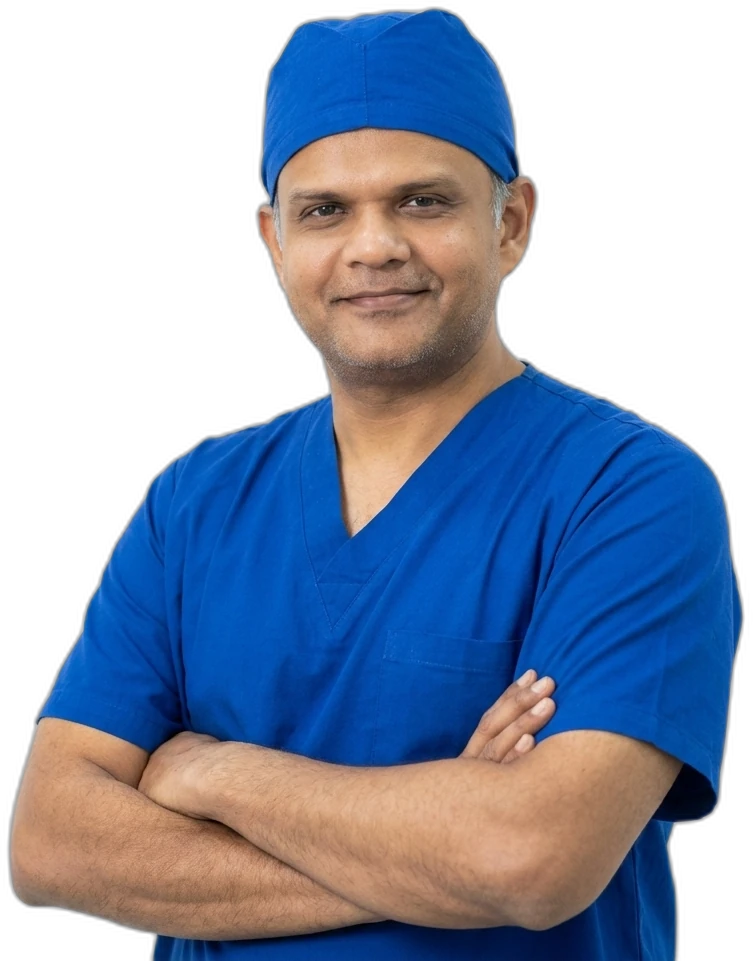
Dr. Babu Elangovan is a Surgical Gastroenterologist and Liver Transplant Surgeon in Chennai, involved in 230+ transplants. His academic fatty-liver work at Sathyabama informs how seriously staging is taken. It does not replace standard care. See fatty liver research in Chennai.
Start with a physician, until these flags appear
A family physician or medical gastroenterologist / hepatologist is the right first door for:
- New "grade 1–2 fatty liver" on a health check
- Mild enzyme bumps and metabolic syndrome
- Alcohol reduction and diabetes optimisation
- Repeat ultrasound or first FibroScan
Stay there while stiffness is low, you are compensated, and imaging shows no worrying lesion. Lean patients still need proper staging, which is why we wrote fatty liver without obesity, but most of them do not start in a surgical clinic either.
When to add a liver / GI surgeon
Book Dr. Babu, or an equivalent HPB / transplant surgeon, when any of the following is true:
1. Advanced or rising fibrosis
F3–F4 band on FibroScan, or clinical suspicion of bridging fibrosis or cirrhosis, especially with diabetes. The question becomes surveillance, portal hypertension work-up and whether transplant evaluation should start, not another year of "watch the ultrasound grade."
2. A liver lesion or suspected HCC
Nodules on ultrasound, CT or MRI in a fatty or fibrotic liver need HPB-level reading. Selected hepatocellular carcinomas are treated with resection or transplant if they meet criteria. This sits inside HPB surgery and liver transplant.
3. Decompensation
Jaundice with dropping albumin or rising INR, ascites, encephalopathy or variceal bleeding means the liver is failing to compensate. That is transplant-evaluation territory, not a lifestyle-only visit. Surgery and hepatology work together from here.
4. A transplant plan that is unclear
Listing, living versus deceased donor, MELD, and what the hospital stay looks like should be explained in plain language. What happens during liver transplant evaluation and living vs deceased donor cover the process. A clinic visit settles your file.
5. Bariatric surgery with significant NASH
Obesity plus progressive fatty liver is a reason to involve both metabolic surgery and liver staging. Eligibility is set out in am I eligible for weight-loss surgery. The liver question is whether inflammation or fibrosis changes operative risk and follow-up. See bariatric & metabolic surgery.
6. Discordant tests
Normal LFT plus high stiffness, or ultrasound "mild fat" plus F3. Someone has to own the next test: repeat FibroScan, MR elastography, or biopsy. A transplant-trained surgeon is used to that discordance.
One flag is enough to ask for a surgical opinion. Waiting for pain is a poor filter; the liver has few pain fibres.
What surveillance looks like once the liver is cirrhotic
Patients often arrive at a surgical clinic with an F4 reading and no surveillance plan. Two things should already be running:
- HCC screening. Ultrasound of the liver every six months, with or without an AFP blood test. A new nodule on a background of cirrhosis is treated as cancer until proven otherwise, and small tumours caught this way are the ones that qualify for resection or transplant.
- Varices screening. An upper endoscopy to look for oesophageal varices, then repeat at an interval set by the findings and platelet count. Some patients with a low stiffness and normal platelets can skip the scope under current guidance; that decision belongs to the clinic, not to the patient.
If neither has been ordered, that alone is a reason to see someone who does this every week.
Bariatric timing and the fibrosis stage
The sequence matters. A sleeve or bypass in a patient with F0–F2 NASH is straightforward: weight loss improves liver fat and inflammation over the following year, and the liver is not the limiting risk.
At F3, the operation is still reasonable in most patients but the liver should be staged properly first, with a stiffness reading, platelets and a look for portal hypertension. At F4 with compensated cirrhosis, bariatric surgery is possible in selected patients at centres with liver expertise, but decompensated cirrhosis is a contraindication. At some transplant centres, selected patients with obesity and cirrhosis are offered transplant with a sleeve done at the same time or later. That is exactly the conversation a combined bariatric and transplant clinic exists for.
What a surgical consult actually decides
You should leave knowing:
- Whether this is still medical MASLD or already surgical / transplant disease
- What imaging or endoscopy (varices) is still missing
- Whether liver transplant evaluation should start, wait, or is unnecessary
- Whether HPB resection is on the table for a lesion
- How bariatric timing interacts with liver risk, if relevant
In practice this is one visit. Tests that are commonly ordered on the same day, if not already done: a full LFT with albumin and INR, complete blood count for platelets, viral serology, AFP, and a triple-phase CT or MRI if there is a lesion or the ultrasound was inconclusive. Endoscopy is booked separately. Most patients have a clear answer to "which bucket am I in" by the end of the first visit and a written plan within a week of the imaging.
Bring: ultrasound, CT or MRI films or disc, the FibroScan PDF, full LFT with ranges, viral serology if done, HbA1c, and any outside transplant letter. If you have already been told to list for transplant, the letter should state the aetiology, the MELD or Child-Pugh score, whether varices and HCC screening were done, and whether a living donor has been discussed. If it says less than that, the plan is not yet a plan.
Second opinions for outstation families
Families from elsewhere in Tamil Nadu, Andhra, Kerala or the North-East often send reports first. That works. Share the imaging as DICOM files or a disc, not a phone photo of the report, plus the FibroScan PDF and the last two sets of bloods. A video consult can sort the "medical or surgical" question and decide whether the trip to Chennai is needed at all. If it is, the in-person visit is planned so that any missing imaging is done the same day.
A second opinion that confirms the original plan is a good outcome. It is not a wasted trip.
Chennai locations and next step
Dr. Babu consults at Mira Health Care (Adyar), Kauvery Hospital (Alwarpet), Capstone Clinic (T. Nagar), Kumaran Hospital and THANC Hospital (Kilpauk). Book an appointment or call +91 99626 60009.
General information, not personal medical advice. Seek emergency care for vomiting blood, black stools, jaundice with confusion, or sudden tense abdominal swelling.
Authored by