FibroScan (Liver Stiffness Test) in Chennai: What F0–F4 Means
Need expert consultation? Book an appointment with Dr. Babu Elangovan.
Book AppointmentA fatty-liver ultrasound often ends with one word: grade 1, 2 or 3. That grade describes how bright the liver looks on the screen. It says almost nothing about scar. People searching for FibroScan Chennai or liver stiffness test have usually worked that out already: they want a number that tracks fibrosis, not another enzyme printout that reads "almost normal."
This guide explains what transient elastography measures, what the F0–F4 bands mean, when a reading should not be trusted, and how Dr. Babu Elangovan, Surgical Gastroenterologist and Liver Transplant Surgeon, uses the numbers in clinic. If your question is how fatty liver progresses in the first place, start with fatty liver: when does it become serious. If you want to know whether the fat can be undone, the stage-by-stage answer is in can fatty liver be completely reversed. For the blood panel that usually arrives with the scan, see how to read your LFT.
What a FibroScan actually measures
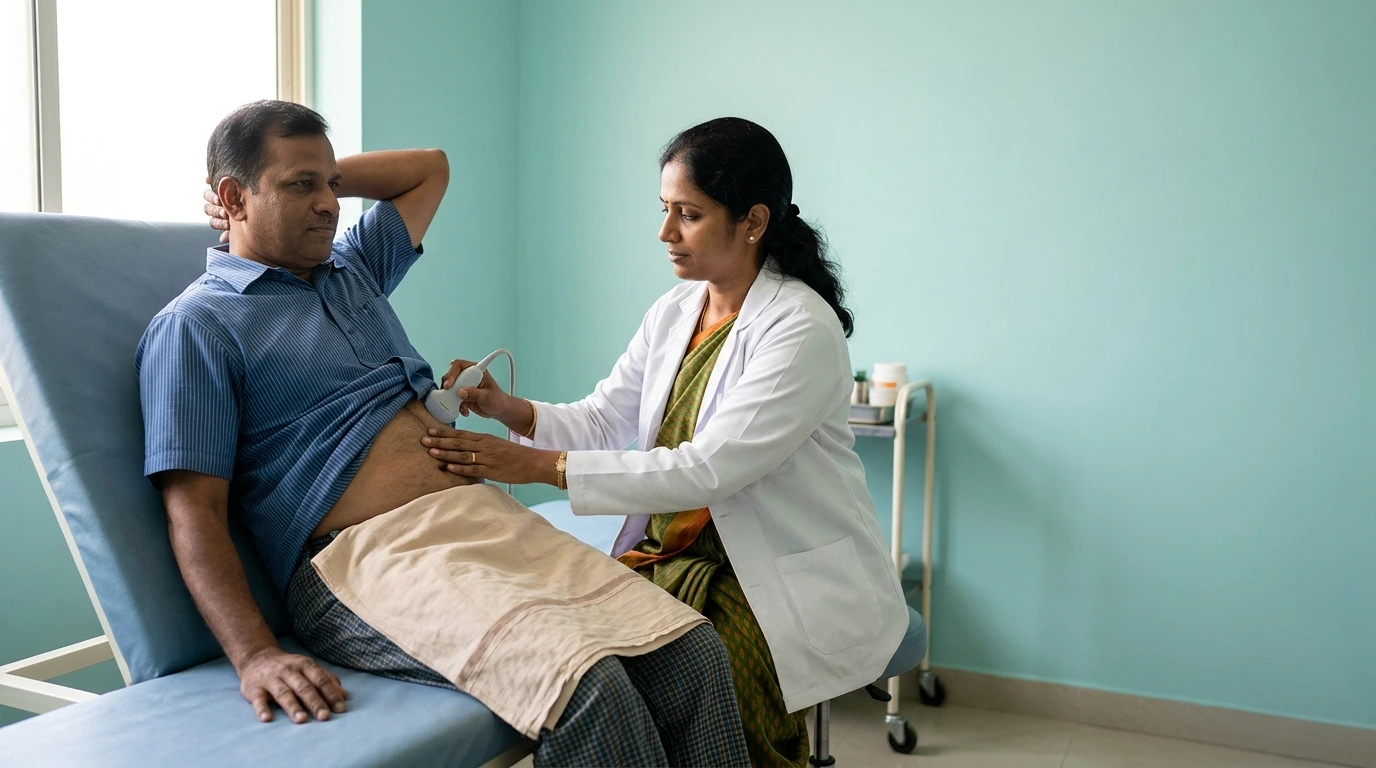
A FibroScan (transient elastography) rests a probe between the right lower ribs and sends a low-frequency mechanical pulse into the liver. Ultrasound tracks how fast that shear wave travels. Stiff, scarred tissue transmits it faster than soft, healthy tissue. Software converts the speed into two practical numbers:
- CAP (controlled attenuation parameter), in dB/m. This estimates how much fat is stored inside hepatocytes. Values above roughly 248 dB/m suggest steatosis and values above roughly 280 suggest more marked fat, though thresholds differ between studies and machines.
- Liver stiffness (LSM), in kilopascals (kPa). This estimates how hard the tissue is, which is the surrogate for scar.
The test is outpatient, painless, needs no contrast, no sedation and no needle. You lie on your back with the right arm behind your head. The operator takes at least ten valid readings, usually in five to ten minutes. It is not a CT, not an MRI, and not a biopsy. It is a staging aid for the question "how much fat, how much scar?" A tumour question still needs cross-sectional imaging.
Dr. Babu uses FibroScan-led staging in clinic and in academic fatty-liver work at Sathyabama Institute. That research does not change what happens at your visit: care rests on history, examination, labs and validated imaging, not on unpublished assays. Background is on the fatty liver research page.
F0–F4: reading the fibrosis band
Stiffness is mapped to a fibrosis band. Treat it as a range, not a courtroom verdict:
| Band | Typical meaning | What it usually implies |
|---|---|---|
| F0–F1 | Little or no significant fibrosis | Metabolic work and follow-up; scar is not the main problem yet |
| F2 | Moderate fibrosis | Tighten diabetes, weight and alcohol; repeat stiffness, do not ignore |
| F3 | Advanced / bridging fibrosis | Closer surveillance; surgical or transplant review if other flags appear |
| F4 | Cirrhosis-range stiffness | Assess compensation, varices risk, HCC screening: specialist territory |
For metabolic fatty liver (MASLD), the ranges quoted most often run roughly like this: below about 8 kPa, advanced fibrosis is unlikely; 8 to 12 kPa is an indeterminate zone that needs a second test or a repeat; above 12 to 15 kPa, advanced fibrosis or cirrhosis becomes likely enough to act on. Alcohol-related and viral liver disease use slightly different cut-offs. Manufacturers publish their own tables. This is why a single kPa without context is incomplete.
Several things inflate stiffness without adding scar:
- Active inflammation. An ALT of 200 during a hepatitis flare stiffens the liver temporarily.
- A recent meal. Portal blood flow rises after eating, and so does the reading. Hence the fast.
- Congestion. Heart failure or a blocked hepatic vein pushes kPa up.
- Cholestasis. A blocked bile duct with jaundice does the same.
- Alcohol in the last few days. Stiffness falls measurably after a period of abstinence.
Reading the quality line matters as much as the number. A reliable study has at least ten valid shots and an interquartile range (IQR) below 30% of the median. If your report shows six valid shots with a wide IQR, the honest response is a repeat, not a stage.
Two reports, same number, different meaning
Report A. A 46-year-old with type 2 diabetes, waist 102 cm, fasted, LFT normal, CAP 310, stiffness 11.2 kPa, IQR 12%. Nothing here is acute. That 11.2 sits in the indeterminate-to-concerning zone in a patient with the strongest metabolic risk profile there is. He needs a second fibrosis test, a diabetes review and a plan, not reassurance because his enzymes are normal.
Report B. A 31-year-old two weeks after dengue, ALT still 180, not fasted, CAP 240, stiffness 11.4 kPa, IQR 28%. Same kPa. Here the inflammation, the meal and the borderline IQR explain most of it. The right move is to repeat in eight to twelve weeks after the liver has settled, fasted, and only then draw a conclusion.
The number is identical. The decision is not. That is the whole argument for having a clinician read the scan rather than a search engine.
FibroScan vs ultrasound vs LFT
| Test | What it is good at | What it misses |
|---|---|---|
| LFT | Cell leak (ALT/AST), bile stress (ALP/GGT), synthetic function (albumin, INR) | Significant fat or scar with "normal" enzymes |
| Ultrasound | Visible fat, size, ducts, obvious masses | Quantified stiffness; mild fat under-called |
| FibroScan | CAP fat fraction + kPa stiffness | Tumour mapping; cause of disease; biopsy-level histology |
Use them together. An ultrasound that says "grade 2 fatty liver" plus a normal LFT is not clearance. Ask what the stiffness is. Conversely, a FibroScan does not replace ultrasound or MRI when a nodule or a bile-duct problem is the question.
Many clinicians add a cheap gate before the scan: the FIB-4 score, calculated from age, AST, ALT and platelet count. A FIB-4 below about 1.3 in a younger adult makes advanced fibrosis unlikely and a scan can wait. A value above roughly 2.67 makes the scan, and a specialist visit, hard to justify skipping. In between, FibroScan is the tiebreaker. Ask your physician to calculate it from the LFT you already have.
How to prepare, and when the reading is unreliable
Typical advice (confirm with the centre that books you):
- Fast for about three hours unless told otherwise. Water is fine.
- Avoid alcohol for several days before the test if you can.
- Bring prior ultrasound, LFT, HbA1c, lipid profile and any MRI or CT.
- Wear clothing that allows probe access between the ribs on the right.
Readings are harder with large ascites, a narrow intercostal space, or a breath that will not hold still. A high BMI is not a reason to skip the test: the XL probe is built for a thicker chest wall and most larger centres carry one. Ask for it if your BMI is above about 30 or the M probe keeps failing.
Do not rely on a single scan if any of these apply: acute hepatitis in the last three months, known heart failure, obstructive jaundice, or a drinking session in the last week. Fix the confounder, then measure.
Lean patients can still have metabolic fatty liver, and BMI is not a FibroScan exemption. If your BMI is normal and the ultrasound still says fatty liver, read fatty liver without obesity.
What the visit looks like
You register, confirm you have fasted, and lie down. The operator marks the right lower ribs, applies gel, and takes readings while you breathe normally with short holds. The printout shows CAP, median stiffness, IQR and the number of valid shots. Most centres hand it over the same day. Dr. Babu reads it alongside your ultrasound, LFT and metabolic bloods at the consult.
Bring the FibroScan PDF, not a cropped WhatsApp photo of one number. The IQR and valid-shot count are the part people crop off, and they decide whether the number can be trusted.
How Dr. Babu uses FibroScan in Chennai
In clinic, stiffness helps sort three conversations:
- Lifestyle and metabolic control. Early fat, low stiffness: prove change with a repeat CAP and kPa in six to twelve months, not with a "liver tonic."
- Closer surveillance. Rising or high stiffness, diabetes, or suspected NASH fibrosis: shorter follow-up, six-monthly ultrasound for HCC screening once the picture is cirrhotic, and endoscopy for varices when indicated.
- Surgical or transplant review. Decompensation, a lesion, or discordant tests that may need MR elastography, biopsy or HPB imaging. The referral triggers are spelled out in when fatty liver needs a liver surgeon.
Consultations are at Mira Health Care (Adyar), Kauvery Hospital (Alwarpet), Capstone Clinic (T. Nagar), Kumaran Hospital and THANC Hospital (Kilpauk). Book an appointment or call +91 99626 60009.
This article is general information, not personal medical advice. FibroScan bands are interpreted with your full history. Seek urgent care for jaundice with confusion, vomiting blood, or black stools.
Authored by