Who Can Be a Living Liver Donor in India?

Need expert consultation? Book an appointment with Dr. Babu Elangovan.
Book AppointmentWhen a loved one needs a liver transplant, families often ask the same first question: who can be a living liver donor in India? The answer sits at the intersection of law, medicine, and ethics. India allows living donation so that a carefully screened volunteer can give part of their liver, but only under strict rules designed to protect donors and prevent commercial exploitation.
This guide explains who the law allows to donate, the medical fitness checks that apply, how evaluation runs step by step, and what recovery looks like for the donor. If your family is still weighing the two organ sources against each other, start with living donor vs deceased donor liver transplant. If no living donor is available, liver transplant waiting list, MELD and TRANSTAN explains how deceased-donor livers are allocated in Tamil Nadu.
Dr. Babu Elangovan, Surgical Gastroenterologist and Liver Transplant Surgeon in Chennai, has more than 20 years of experience and has been involved in 230+ liver transplants covering both donor and recipient surgery. He guides families through counselling, evaluation, surgery, and long-term follow-up under a single-surgeon continuity model.
Why Living Liver Donation Exists
The liver can regenerate. When a healthy adult donates a portion (often the right lobe for an adult recipient, or a left-sided graft in selected cases), both the remaining liver in the donor and the transplanted portion in the recipient enlarge over subsequent weeks to meet the body’s needs.
That biology makes living-donor liver transplant (LDLT) in Chennai a planned option when a suitable relative is available. It can reduce the uncertainty of waiting for a deceased-donor organ, which matters when a patient’s condition is deteriorating.
Living donation is never casual. It is major surgery for a healthy person, so the law and clinical teams set a high bar: voluntary consent, clear relationship (or approved special circumstances), and medical fitness that protects the donor first.
Legal Eligibility: THOTA and Near Relatives
Living organ donation in India is regulated under the Transplantation of Human Organs and Tissues Act (THOTA) and related rules. Commercial dealing in organs is prohibited. Consent must be free of coercion and payment.
Near-relative donors
For most families, the pathway is near-relative donation. Near relatives generally include:
- Spouse
- Mother and father
- Son and daughter
- Brother and sister
- Grandfather, grandmother, grandson, and granddaughter
Genetic relationships are documented with prescribed forms and supporting identity proof. Spousal donation uses its own documentation pathway. Hospitals and competent authorities verify relationship before surgery is approved.
Other than near-relative donors
A person who is not a near relative may donate only for reasons of affection, attachment, or another special reason, and only after Authorization Committee scrutiny. Interviews and documentation check that the gift is genuine and not commercial. Process timelines and e-verification requirements have been tightened in recent central guidance; your transplant centre will list the exact forms needed for your case.
Important legal boundaries
- Donation from a minor is not considered without exceptional prior approvals under notified guidelines.
- An Indian living donor cannot donate to a foreigner unless they are near relatives.
- Swap transplants between unmatched near-relative pairs may be considered under defined rules; mixed Indian–foreigner swap pairs are not allowed under the Act’s framework.
Legal clearance is necessary but not sufficient. Medical evaluation still decides whether donation is safe.
Medical Criteria: Who Is Usually Fit to Donate
Exact cut-offs are individualised after tests, but clinical teams typically look for:
| Area | What teams usually assess |
|---|---|
| Age and maturity | Adult donor with capacity to consent; upper age judged case by case with cardiac and liver reserve |
| Blood group | Compatible ABO matching with the recipient |
| Liver health | Normal liver function; no significant fatty liver, fibrosis, or viral hepatitis that would endanger either person |
| Body habitus | Anatomy and volume that leave enough liver for the donor and enough graft for the recipient |
| General fitness | Heart, lung, kidney, and metabolic health adequate for major surgery |
| Psychology and social support | Clear understanding of risks; voluntary decision; support for recovery |
A compatible blood group and willingness are only the starting point. Many motivated relatives are deferred because imaging shows unsuitable anatomy, significant fatty change, or another medical risk. Deferral protects the donor. It is not a moral failure.
If you are preparing for transplant work-up more broadly, what happens during liver transplant evaluation explains the recipient-side process that runs in parallel.
Step-by-Step Living Donor Evaluation
Donor evaluation is structured and usually staged so that invasive or high-cost tests come after basic screening is clear.
1. Counselling and consent
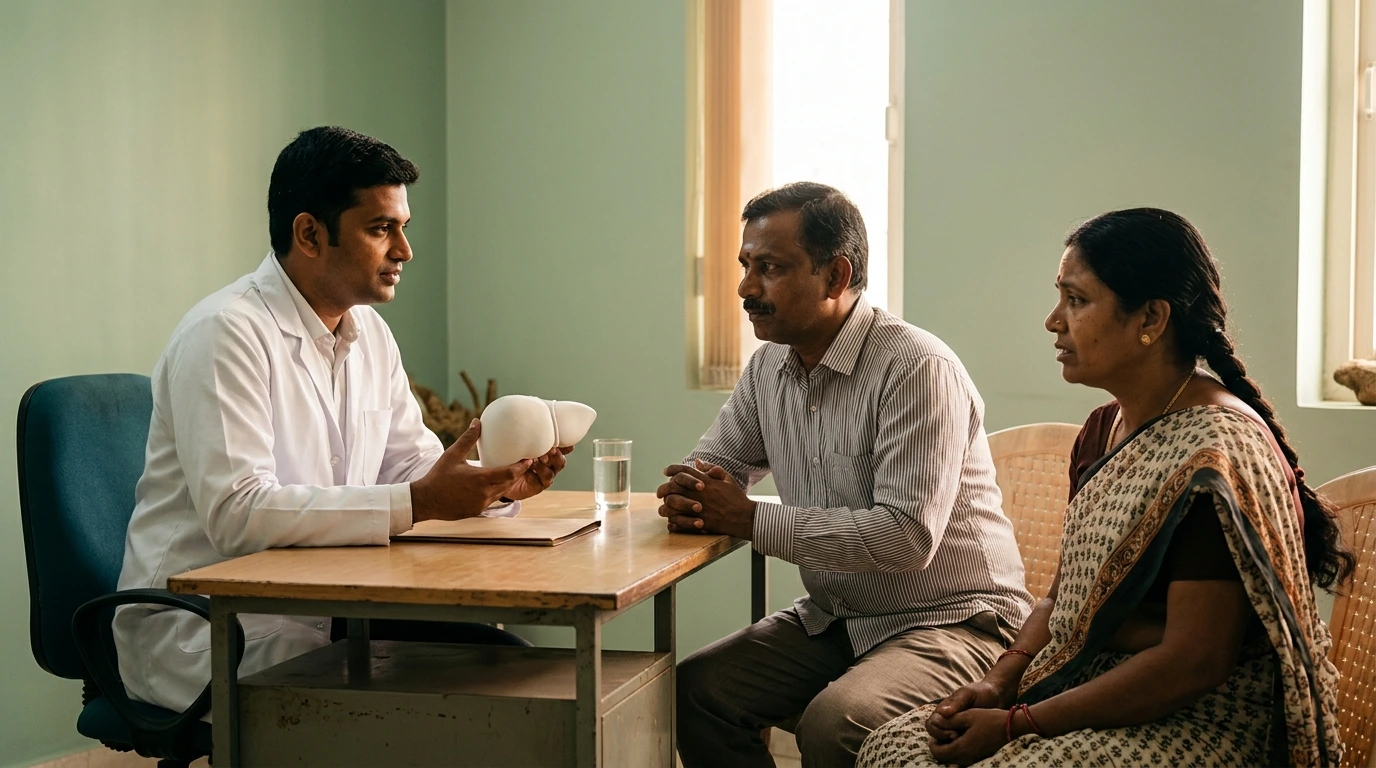
The surgical team explains LDLT, alternatives (including deceased-donor listing), risks to the donor, expected hospital stay, and time off work. The donor should feel free to decline at any stage without pressure from the family or the medical team.
2. Basic blood and infection screening
Blood group, complete blood count, liver and kidney tests, coagulation profile, and viral markers are reviewed. Abnormal results may pause or stop the pathway early.
3. Imaging and volumetry
CT or MRI maps the liver’s blood vessels and bile ducts and estimates volumes. Surgeons need enough remaining liver for the donor (future liver remnant) and enough functional graft for the recipient. Unsafe anatomy is a common reason to stop.
4. Cardiac and anaesthesia fitness
ECG, echocardiography, and further cardiac tests when indicated assess whether the donor can safely undergo prolonged anaesthesia and recovery.
5. Psychological and social review
Independent assessment helps confirm understanding, voluntary intent, and home support for the recovery period.
6. Legal documentation and approval
Near-relative cases proceed through competent authority pathways with the required forms. Non-near-relative cases go to the Authorization Committee. Surgery is scheduled only after medical and legal clearance.
If you or a relative is being evaluated as a donor and the process feels confusing, early counselling with the transplant surgeon helps set realistic expectations before emotional momentum overtakes medical facts. Request a consultation with Dr. Babu Elangovan at his Chennai consulting locations.
Common Reasons Living Donors Are Deferred
Families benefit from knowing typical stop points in advance:
- Significant hepatic steatosis (fatty liver) that raises donor and graft risk
- Inadequate future liver remnant or unsuitable vascular/biliary anatomy
- Uncontrolled diabetes, heart disease, or other major comorbidity
- Active infection or incomplete cancer screening where required
- Blood-group incompatibility without an approved alternative pathway
- Psychological unreadiness, coercion concerns, or weak post-operative support
- Incomplete legal documentation for relationship or Authorization Committee requirements
Sometimes a second relative can be evaluated. Sometimes the safer plan is deceased-donor listing while the recipient is medically optimised.
Risks, Regeneration, and Donor Recovery
Risks (spoken plainly)
Living liver donation is major abdominal surgery. Possible complications include bleeding, bile leak, infection, temporary digestive changes, hernia at the incision, and anesthesia-related events. Serious complications are uncommon in carefully selected donors at experienced centres, but “uncommon” is not “impossible.” Donor safety remains the first design principle of the operation.
Regeneration
Over roughly six to eight weeks, remnant and graft volumes typically increase substantially. Function improves as volume recovers, which is why both donor and recipient need structured follow-up rather than a single post-operative visit.
Recovery timeline (typical ranges)
- Hospital stay often about one to two weeks for uncomplicated donors
- Gradual return to light routine over several weeks
- Many donors resume desk-type work around four to six weeks when cleared
- Heavy lifting and strenuous exercise wait until the surgical team agrees
Recipients follow a longer recovery arc, including lifelong immunosuppression. Practical guidance is covered in life after liver transplant: diet, exercise, work and travel.
Living Donation vs Waiting for a Deceased Donor
Living donation offers a planned date when the recipient is as optimised as possible. Deceased-donor transplant depends on organ availability, blood group, urgency category, and state allocation rules. In Tamil Nadu, that system is coordinated through TRANSTAN and is not a simple “highest MELD always gets the next liver” queue. The details are in the waiting list guide.
Many families evaluate both paths at once: complete recipient evaluation, list for deceased donation where appropriate, and screen willing near relatives for LDLT. The right choice depends on illness severity, donor availability, and surgical judgement, not on a single internet checklist.
How Dr. Babu Elangovan Supports Donor Families in Chennai
Donor and recipient surgery must be coordinated with precise anatomy planning and honest counselling. Dr. Babu Elangovan’s practice emphasises:
- Clear explanation of legal and medical eligibility before hope hardens into pressure
- Rigorous donor-first evaluation
- Continuity from clinic assessment through surgery and follow-up
- Access across five Chennai consulting locations, with remote second opinions for outstation families
For personalised advice on living liver donor eligibility, book an appointment or call +91 99626 60009.
References
- Ministry of Health and Family Welfare / DGHS. Transplantation of Human Organs and Tissues Act (THOTA) framework and National Organ Transplant Programme overview.
- NOTTO. Living donor transplant forms and documentation guidance under the Transplantation of Human Organs and Tissues Rules.
- Transplant Authority of Tamil Nadu (TRANSTAN). State organ donation and transplantation information for Tamil Nadu.
- American Association for the Study of Liver Diseases (AASLD). Guidance on evaluation of living liver donors (international clinical reference).
- Indian Society of Organ Transplantation (ISOT). Practice perspectives on living donor liver transplantation in India.
Authored by